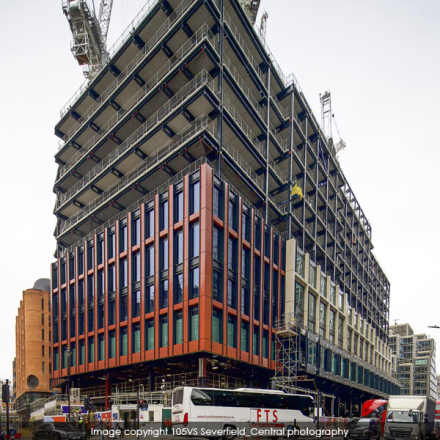
Project Description :
Severfield provided structural steel solutions for the redevelopment of 334 Oxford Street, which was developed following the partial demolition of the existing building, which was previously Debenham’s flagship store in London. This transformation extends the building, creating a modern retail, leisure, and flexible office space, now named ‘The M Building’.
Severfield supplied and installed the structural steelwork, intumescent paint, and metal decking for the new structure, including the connections of new steel to the retained steel frame and the newly built central concrete core.
The scheme involved a complex repurposing of the original six-storey structure, which was built in the 1960s and 1970s. The project included the partial retention of the building, along with significant alterations and extensions. The existing façade was removed, and the north and west sections of the building, along with the existing cores, were demolished.
A key priority for the client was to minimise the embodied carbon of the building, a goal which Severfield is fully aligned with.
An embodied carbon target of 83 kg CO2e/m² was committed to and was achieved by incorporating reused steel, Electric Arc Furnace (EAF) metal decking into the design. This approach reflected our ongoing dedication to sustainability and our role in helping clients reduce their carbon footprint.
Optimisation of Intumescent protected beams
Working alongside the Engineer, AKTII, Severfield identified beams whereby slightly increasing their mass and reducing their surface area would reduce the volume of intumescent paint required. In conjunction with reviewing the steel profiles, AKTII also provided Severfield with their FBEAM design files to enable bespoke Limiting temperatures to be calculated for each beam on the project, further reducing the volume of intumescent paint required.
Taking a holistic view to optimise the steel sections to suit the fire period and intumescent paint product chosen, in conjunction with calculating the bespoke limiting temperature using FBEAM, yielded a net carbon reduction of 99tCO2e or 2.2kgCO2e/m2.